Transport in Sydney before the motor bus
Before delving into the detail of how motor bus routes in Sydney were initiated and numbered over the years, I present some background to the evolution of bus routes in general.
Buses have provided street transport services in and around Sydney almost continuously since 1831, when privately run horse bus services could be said to have commenced (Duncan Macauslan, Ryle’wy – how the horse buses transformed Sydney, published by Transit Australia Publishing in 2016). Many horse bus operations were superseded when government-run steam trams were established in 1879. However, a much greater influence on street passenger transport came about two decades later when the government electrified the city-based tramway system from late 1899 onwards, bringing about the end of many horse bus routes, at least in inner suburbs of Sydney, over a few short years.
The ever-evolving street transport scene moved on a step when the government briefly experimented with steam-driven buses for a few months in 1905-6. At much the same time the first motor bus plied its trade between Manly Wharf and Newport. While that attempt and a couple of others were unsuccessful, it was only a matter of time before motor buses gained acceptance and demonstrated their durability.
Motor bus routes authorised by Government Gazettes
Government Gazettes periodically listed horse bus routes for some years prior to 1911. The issue of the Gazette dated 9 August 1911, however, was the first to contain an item specifically noted as a motor bus route. That route also connected with ferries at Manly and travelled as far as “Curl Curl”, in current Queenscliff
From 1911 to 1917 motor buses continued to be identified separately. After World War I, however, ex-servicemen, armed with both mechanical knowledge from driving trucks in the European theatres of war and witnessing troops being transported along London streets by fleets of double deck motor buses, sought to drive motor buses in Sydney. So from 1919 almost all routes in the Gazette during that year had become motor buses and it was only horse buses which were noted separately.
Some of these early motor bus routes listed in Government Gazettes also ran to and from Manly, but the sphere of operation of motor buses soon expanded to elsewhere in suburban Sydney. Many of the motor bus routes were along busy tram lines and, by the mid 1920s, with the improvement in road standards, these private buses were providing considerable competition for the Government tram and rail systems.
Commencement of route numbers in 1924
No numbers were allocated to bus routes until 1924, by which time 202 motor bus routes were listed in the Government Gazette. Those routes were given numbers starting from 1.
From 1924 route numbers represented the numbers of licences granted to each operator. They were allocated in generally alphabetical order of the principal, non-city terminus of the route, except for routes numbered 1 to 6, which were seemingly in a special category. Thus in the regulations contained in the 19 December 1924 Government Gazette, routes 7 to 15 each had a destination starting with A, routes 16 to 37 a destination starting with B, and so on through to Routes 195 to 203, destinations starting with W.
The numbering system as from 1925
By the following year, 1925, additional routes had commenced and alterations made to others, so the Government Gazette of the 13 November 1925 Gazette listed a revised series of routes/licences. The numbers of most routes changed. But thereafter, the Chief Secretary’s Office, which issued the regulations, possibly succumbed to pressure not to further alter route numbers unnecessarily. The route numbers in that Gazette and the system then remained relatively stable in succeeding Gazettes throughout the 1920s until 1930. Indeed, although lists of routes ceased to be published in Government Gazettes after 1930, the basis for numbering continued till 1981. During this period, when a route ceased, its number was typically, sooner or later, “recycled” to a newly starting route.
Tram routes in Sydney
Throughout the 1920s all buses in Sydney were privately owned and operated. The only street transport then run by the State Government was the extensive network of trams which radiated from the city to many of the then developed suburbs, as well as in some suburban locations. Tram routes were never numbered and were referred to mainly by destination names (for example, the Railway-La Perouse route), although, in certain cases, coloured symbols on destination rolls were also in use to aid identification of routes by the travelling public and signalmen. Hence, it was common to speak of, for example, “the tram with the three green diamonds” when referring to the Circular Quay-Canterbury tram service.
Legislation in the 1930s
Because of the growing competition between Government-run trams and privately operated buses, the Government in the early 1930s passed two pieces of legislation designed, among other things, to severely restrict the extent of that competition. The first of these laws was the Transport Act of 1930, which altered the administration of the State’s transport in such a way that the expansion of the private bus industry was severely curtailed. As this Act failed to make sufficient inroads into the private bus competition, further legislation was enacted.
That further legislation was the State Transport (Co-ordination) Act of 1931, which imposed as from 2 November 1931 a tax on private buses employed on routes that were deemed to be competitive with Government trams or trains. The Government took a wide view as to what constituted “competition”. As a result of this Act, many private bus routes in the Sydney metropolitan area were declared competitive and ceased operation after Saturday, 31 October 1931. Some routes were relicensed by the State Transport (Co-ordination) Board either immediately or in the following months or were otherwise altered to operate as feeder services to tram or railway lines or to later Government bus routes.
For many months after October 1931, public debate raged both over the services that had been discontinued or curtailed and over the relative merits of trams and buses. In the course of this debate, it became obvious that there was still a strong demand for many of the ex-private bus routes and so the Government found itself under pressure to satisfy that demand. Following yet another piece of legislation, the Transport (Division of Functions) Act of 1932, the Department of Road Transport and Tramways (DRTT) was established. One of its functions was to operate trams, trolley buses and buses in Sydney (and Newcastle) and to regulate private bus services. The way thus became clear for the Government through its new department to start its own bus services.
As far as route numbering was concerned, the discontinuance of over 90 routes as from 31 October 1931 (although some later were relicensed as feeders) left many route numbers unused. Almost all of these numbers were in due course re-used, as a result of the growth, particularly after World War II, of the number of Sydney metropolitan private bus routes. Most of the new routes were feeders to suburban railway stations. The allocation of subsequently re-used route numbers was haphazard. By 1952 the range of numbers in use was between 1 and 244.
Government bus operation starts in 1932
Government bus operation commenced on 25 December 1932, when the DRTT recommenced operation of Route 144, Manly-Cremorne Junction. This route reinstated (and extended) one of the private routes discontinued in October 1931. Over the following several years, the extent of Government bus operation grew quite rapidly with the reinstatement or takeover of further private bus routes over a wide area of Sydney. Most of these routes initially continued to use the numbers of the previous private operations.
The three-digit, geographical (later) Sydney Region number system
Within only a few years, practical difficulties arose, as the destination and route number blinds on DRTT buses grew continually longer with more and more private bus routes being taken over. To help overcome these difficulties, a three-digit route numbering system, based on geographical areas, was recommended by an internal Departmental report in 1937-8 and adopted towards the end of 1938. The report also initiated the use of three-track route number rolls on DRTT buses, a system which remained operative on Government (and some private) buses well into the 1990s (although now superseded by electronic destination signs).
The system proposed that numbers of Government bus routes be allocated to geographical areas as follows:
100-199 Manly-Warringah
200-299 Inner north
300-399 East and inner south-east
400-499 Inner west
500-599 Far south-east
600-699 South
700-799 Far west
800-899 Middle west
900-999 North-west
The 100-199 series was almost certainly allocated to bus routes in the Manly-Warringah area because all routes in that area already had numbers in that series, as a result of the numbering of routes in roughly alphabetical order in 1925. In the 1920s, the vast majority of bus routes in that area radiated from Manly Wharf, and so were grouped under “M”. By the mid 1930s, almost all these routes had become Government operated.
It should be remembered that this system was set up for Government buses only and that the areas mentioned refer to the extent of Government bus operation at the time, when Sydney was a much smaller metropolis than today.
It appears that the geographical number system of Government bus routes commenced in a modest way in late 1938. On 28 November 1938 route 961 (Sydney Region route number) between the City and Homebush via East Concord commenced, replacing a shorter route, 87 (1925 route number) Strathfield to East Concord. In the same financial year (that is, for the year ended 30 June 1939), the Commissioner’s annual report shows that parts of 88 (1925 route number) on the south side of Strathfield station were renumbered 880, 883, 886 & 887 (Sydney Region route numbers), unusually without any specific date being recorded. Ignoring which of those events came first, it is believed that the renumberings were regarded as a trial, prior to the widespread renumbering of routes into the new system, which took place between September 1939 and September 1941. New routes which commenced during the same period were also numbered in accordance with the new system. By 1943, most Government bus routes had been renumbered into this system.
The system revised in 1943
When the effects of World War II began to bite, the DRTT was forced to curtail several city-to-suburb bus routes to feed to suburban railway stations or tram lines, instead of travelling into the city, so as to conserve scarce resources of manpower and fuel. The curtailment of a batch of such bus routes in this manner as from 14 June 1943 heralded the introduction of a revised and simpler numbering system, which had fewer classifications, as follows:
100-199 Manly-Warringah
200-299 Inner north
300-399 East and south-east
400-499 West and north-west
On that date 880 & 883 were renumbered 480 & 483, while other routes south of Strathfield Station, which had numbers in the 8xx series, were also renumbered into the 4xx series. The DRTT routes, which had by then been given numbers between 500 and 999, were renumbered into this revised system during the remainder of 1943 and in 1944. All regular Government bus routes had by then been numbered between 100 & 499.
Tram-to-bus conversions cause expansion
After the war, the Government recommenced its programme, which had started before the war, to replace the entire Sydney tramway system to Government buses. During the period from 1948 to 1956, some relatively small tram-to-bus replacements occurred and the numbers of the new bus routes so created were easily accommodated in the numbering system, whose general structure had been established in 1943.
By 1957, however, the Department of Government Transport (DGT) – successor in 1952 to the DRTT – realised that there would be insufficient three-digit route numbers to cater for all the Government bus services proposed to replace the remaining tram lines. The need for more route numbers was accentuated by the then current policy of allocating a separate number for every short-working of a bus route. In those days, there were considerably more short workings on Government bus routes than there are today.
To create more route numbers, two steps were taken during 1957:
- on 24 June 1957 (coincident with the replacement of the Clovelly, Rosebery and Daceyville tram lines by buses), peak hour industrial routes in the eastern, south-eastern and western suburbs, which had till then been numbered in the relevant geographic series, were renumbered into the 000-099 series;
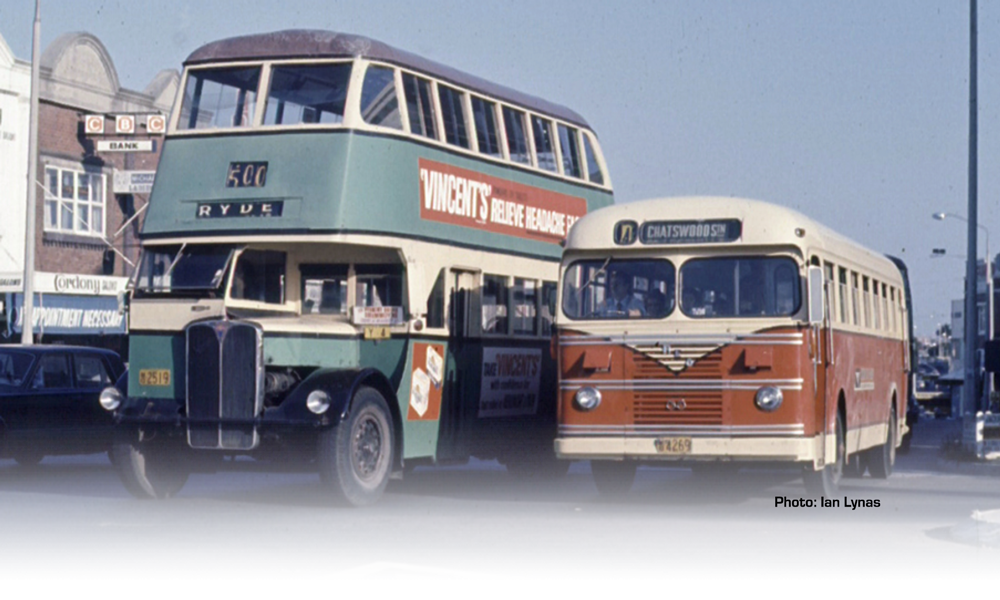
- on 28 July 1957, bus routes which ran between the city and the Drummoyne, Gladesville and Ryde areas over the Glebe Island and Iron Cove Bridges and via Victoria Road, which had till then been numbered from 400 to 410, were renumbered into a series between 500 and 541. At the same time, 455 (Ryde-West Meadowbank [now Melrose Park]) was renumbered for a short time as 555, but later again as 505.
These two steps together provided the DGT with a significant increase in the number of available route numbers, particularly between 300 and 499. The tram-to-bus replacement progr3572amme, which proceeded until its completion on 25 February 1961, used many of the additional route numbers so created.
Duplication of route numbers
Throughout the period since 1925, the range of numbers and the system of allocating them to private bus routes (administered by the relevant Government department, which by the 1960s was the Department of Motor Transport) did not vary, despite the continually evolving number series for Government bus routes, administered by the operator itself. Until about 1952, the two systems co-existed with some apparent degree of co-operation, as little or no duplication of route numbers occurred. But, thereafter, duplication of numbers between the private and Government systems crept in and continued unabated until 1981, when the then Urban Transit Authority (UTA) set about rationalising bus route numbers throughout Sydney. It was only in late 2004 that duplication was finally eliminated.
Private route numbers with multiple routes
Not only was there duplication between Government and private bus route numbers, but within the private bus route number series, there was also duplication, because, when the number of routes covered by a single licence grew, the one route number continued to be used for all the routes covered by the licence. Thus, for example, 56 was at first allotted to a single route from Chatswood to East Roseville, but, as the population of the “Forest” district expanded, particularly after World War II, the number of bus routes authorised by that license grew, so that by the 1992 there were eight separate routes, all with route number 56, which were subsequently renumbered 277-284 in the Sydney Region number system (see below).
Other significant examples of route numbers with multiple routes were 2, 25, 40, 41, 44, 51, 56, 57, 58, 61, 65, 70, 80, 93, 94, 102, 114, 148, 187, 191, 200, 206 and 215.
The extent of these duplications can also be gauged by the fact that the number of private bus route numbers, which before 1981 had never exceeded a little over 200 (as there were always some blanks in the range between 1 and 244), by 2005 exceeded 300 in the new series, with the allocation of separate numbers to individual routes.
This defect in the route numbering system also persisted until the UTA embarked on its rationalisation programme from 1981 onwards.
The first signs of change – the Red Arrow routes
On 18 February 1980, a new bus operator, Bankstown-Parramatta Bus Service (a joint venture of Chester Hill-Bankstown Bus Service and Delwood Bus Company), commenced running a route between Bankstown and Parramatta via Chester Hill through the “territories” of the two joint venture companies. It was rather grandly hailed as “Sydney’s first cross-country bus service”. Initially it ran without a route number, but by at least 17 June 1980, when there was a timetable revision, it had been numbered (possibly somewhat arbitrarily) as 320 and labelled as a “Red Arrow Express Bus Service”. The numbering of this service was the first break away from the traditional (1925) 1-244 numbering system for private bus services.
In total, five routes branded as “Red Arrow” were commenced in the years between 1980-1984 and continued for varying periods. Their initial route numbers were 300, 320, 333, 590 & 860 and each (other than 860) was jointly run by two operators, through whose territory the routes ran. The introduction of the routes was co-ordinated by the UTA, in which power had by then been vested to assist private bus operators with the development of their services.
Not described as a “Red Arrow”, but another route, numbered in the emerging Sydney Region system was 270, a weekday peak-hour only service between Gordon and Duffy’s Forest, run by Forest Coach Lines. Starting on 2 February 1982, its introduction was co-ordinated by the UTA, similarly to the “Red Arrow” routes. It is thought that it was allocated the number 270 in an attempt to anticipate the number that may have been allocated to it under the then still developing Sydney Region numbering scheme. That route ceased in 1992 and its number recycled to a new route between the City and Terrey Hills, run by the same operator.
The Sydney Region route number series
By way of background to the introduction of the new Sydney-wide number series, the State Government in 1972 set up a new body, the Public Transport Commission (PTC) of NSW, to assume control of all the State’s government operated public transport, which at that stage comprised:
- State-wide railways, previously run by the Department of Railways,
- Government-owned buses in Sydney and Newcastle, previously run by the Department of Government Transport, and
- Government-owned ferries in Sydney, previously run by the Sydney Harbour Transport Board.
The PTC, however, proved to be too large and unwieldy and in July 1980 it was split, under the terms of the Transport Authorities Act of that year, into the State Rail Authority (SRA), to run the railways, and the Urban Transit Authority (UTA), to run Government-owned buses and ferries. At the same time, the UTA was given a new function of co-ordinating, although not regulating, all urban public transport throughout the State under a single authority.
To carry out this additional function, the UTA established a Development and Co-ordination Branch, whose role was essentially to help private bus operators with a wide range of assistance. Amongst the activities assigned to this Branch, those relevant to this article were:
- the introduction of new routes, services and operating practices;
- the rationalisation of existing bus routes and improvement of services;
- the preparation, printing and distribution of timetables featuring not only improved services, but also enhanced presentation, including times of connecting trains and route maps, which most private bus operators’ timetables were then lacking.
It should be noted that the Department of Motor Transport continued for some time to authorise private bus operations and generally to control private bus operators.
As part of the UTA’s Development and Co-ordination Branch’s remit to assist certain bus operators to rearrange their routes into more rational networks and provide timetable assistance where required, it established a unified and more meaningful route number system for the whole of the Sydney metropolitan region, designed to cover the routes of both the UTA and private operators. Titled the Sydney Region route number system, it was regarded as one of the means of rationalising bus routes. It is based around nine geographic areas, which took account of the predominant pattern of route numbers already in use by Government-operated buses, but was expanded to cover the rest of the Sydney metropolitan area. The areas which initially applied and the route number series which applied to them were:
100-199 Manly-Warringah area
200-299 North Shore line
300-399 Eastern suburbs
400-499 Inner west south-west
500-599 Inner north-west
600-699 Outer north-west
700-799 Outer west (from Parramatta westwards)
800-899 Outer south-west (Parramatta-Campbelltown)
900-999 Mid south-west (Parramatta-Hurstville-Cronulla)
The first private bus route to be given a number in the new number series was 800, then Parramatta-Cabramatta, as from 2 November 1981. This route resulted from the amalgamation of part of 45 Cabramatta-Edensor Park and 167 Parramatta-Smithfield (1925 route numbers), after the two routes had come under the same ownership in August 1981.
Progress towards finalising the new system
After 1981 there were some changes to the boundaries of the geographic regions. For example, the 200-299 series was originally to apply to all routes connecting with or close to the full length of the North Shore railway line (hence the use of 270 for the Gordon-Duffy’s Forest service, mentioned above). In connection with this, it was envisaged that the numbers of some Government bus routes in the Mosman area would change from the 2xx series to the 1xx series. However, it did not prove possible to renumber these Mosman routes in the short term (although such renumbering was eventually partly implemented in 2020). It was also planned that the proposed boundary between 2xx numbers and 5xx numbers would be at Gordon. However, when Sydney Region numbers were eventually allotted to North Shore routes, 5xx series numbers were in fact used for services as far south as Chatswood. The 600-699 series was later extended to cover routes on the Blue Mountains as far west as Mount Victoria.
In the early 1980s new route numbers for private bus services were generally introduced in conjunction with route and timetable rationalisation programmes undertaken by the UTA. In some later instances, however, private operators renumbered their routes on their own initiative, although in accordance with the overall UTA scheme.
Later in the 1980s the UTA’s Development and Co-ordination Branch was renamed the Operations Branch and this branch continued to be responsible for the numbering scheme until all functions related to the control of private bus routes and services were passed to the Department of Transport (DoT) in 1988. The Department later became known as the Ministry of Transport (MoT) and now Transport for New South Wales (TfNSW). The 1988 change was part of a general rearrangement of the functions of government agencies involved in roads and transport which resulted from the enactment of the Transport Administration Act of 1988. Another change effected at that time was the renaming of the UTA as the State Transit Authority (STA).
Prior to the passing of this responsibility from the UTA to the DoT, the UTA’s Operations Branch had prepared a discussion draft, dated May 1986 and entitled Sydney Region Bus Route Number System: Guidelines and Lists of Routes. This document set out guidelines for the system which had then been under way for over four years, explanations for each series of numbers, a list of routes according to the new route number system and a list of current route numbers showing proposed changes.
Contracts under the Passenger Transport Act
With the shift of responsibility for private bus operations to the DoT/MoT, the impetus to continue with renumbering routes into the new series waned for a few years. It was only after the passage of the Passenger Transport Act in 1990 and the associated introduction of performance-based contracts that renewed efforts were made to bring the remainder of Sydney’s privately operated bus routes under the Sydney Region numbering scheme. This came about when the DoT included in its letters of offer of contracts under the Act a condition that routes be renumbered into the new series, where such renumbering had not already occurred. Where appropriate, these letters of offer specified the ranges of route numbers applicable to the operator.
As a result of introducing the contract system for regulating bus services, all private routes not previously renumbered into the new Sydney-wide series were eventually dealt with (except “Camden Country” routes). The last route to be renumbered from the older to the newer route number system was combined 74/106 (Hurstville – Connells Point) which became 953 in December 2004, only weeks before implementation of the revised contract region system on 1 January 2005.
While the renumbering was principally aimed at rationalising the route numbers of private bus operators, several routes operated by the State Transit Authority (STA) were also renumbered. This had two effects: (i) it facilitated the renumbering of certain private bus routes into an appropriate geographic series, and (ii) it permitted the grouping of certain STA services, which ran partly over common routes, into sequential sets of numbers.
Revisions of the Passenger Transport Act and regional reviews
Following an enquiry undertaken in 2003 by Barrie Unsworth, a former transport minister and premier, the Passenger Transport Act was revised in 2004 in such a way as to:
- Provide for Government funding of private bus services in NSW;
- Reduce the number of metropolitan bus regions from 87 down to 15, each covering a larger area, enabling bus routes to serve greater numbers of patronage generators; the 15 new contract regions came into effect on 1 January 2005;
- Give authority to the Government, through the Ministry of Transport (MoT), to coordinate bus routes and timetables with operators in each region.
Some of the outcomes of these changes to the Act were:
- The number of bus operators was reduced to between one and four per region; following changes of ownership between 2009 & 2014, there is now only one operator per region.
- A “lead operator” was assigned to each region, where there was more than one operator;
- An initial major review of services was carried out in each region between 2006 & 2010 coupled with community consultation. Subsequently regular reviews have been made of bus routes and timetables in each region and changes to routes and timetables are generally made only as a result of a review;
- Many bus routes have become longer, as routes in one (old) region were amalgamated with those in an adjacent one;
- Memory headways have been included in almost all bus timetables, so making many previous timetables more user-friendly.
The new regions and their approximate geographic coverage are:
| Region number | General Area of Sydney | Principal Suburbs |
| 1 | Outer West | Blacktown – Penrith – Windsor – Richmond |
| 2 | South West beyond Liverpool | Liverpool – Glenfield – Ingleburn – Bringelly – Hoxton Park |
| 3 | South West between Parramatta & Liverpool | Fairfield – Cabramatta – Liverpool – Wetherill Park |
| 4 | North West – Hills District | Parramatta – Blacktown – Rouse Hill – Castle Hill – Dural |
| 5 | Inner South West | Lakemba – Punchbowl – Roselands – Mortdale |
| 6 | Inner West | Sydney Olympic Park – Burwood – Ashfield – Leichhardt – Campsie – Rockdale |
| 7 | Inner North West | North Sydney – Chatswood – Macquarie Park – Epping – Ryde – Parramatta |
| 8 | Lower North Shore & Northern Beaches | North Sydney – Mosman – Manly – Brookvale – Palm Beach |
| 9 | Eastern Suburbs | Bondi Junction – Randwick – Maroubra – Botany – Mascot – Surry Hills |
| 10 | South West beyond Bankstown & Sutherland | Hurstville – Miranda – Menai – Bankstown |
| 11 | Cronulla & Bundeena | Miranda – Caringbah – Cronulla – Kurnell – Bundeena |
| 12 | Upper North Shore & Northern Railway to Hawkesbury River | Chatswood – Gordon – Hornsby – Berowra – Brooklyn |
| 13 | Mid West | Parramatta – Burwood – Bankstown – Liverpool |
| 14 | Forest area | Chatswood – Belrose – Terrey Hills – St Ives |
| 15 | Outer South West | Campbelltown – Narellan – Camden |
Privatisation & consolidation of contract regions
Regions 6 to 9 originally contained exclusively STA routes, and the other regions privately operated routes.
Region 11 was very small geographically, compared with other contract regions, and was consolidated with region 10 on 2 September 2009. Since then the regions with government-operated bus routes have been privatised:
- Contract region 6 (Inner West) on 1 July 2018
- Contract region 7 (Inner North West) on 1 January 2022
- Contract region 8 (Lower North Shore & Northern Beaches on 31 October 2021
- Contract region 9 (Eastern Suburbs) on 4 April 2022.
Route numbers in most regions have remained relatively unaltered in the transition from the older contract areas to the newer areas. However, because changes to routes in Regions 3 and 13 were more widespread than others, some wholesale renumbering of routes occurred there.
The reorganisation and renumbering of routes in Region 13 have resulted in the route numbers allocated to the Picton routes being duplicated by some of the new route numbers in Region 13. There is no current intention to renumber either series of routes, so the duplication of numbers 900, 901 and 911 to 914 will apparently remain for the time being. Such duplication seems to defeat one of the purposes of numbering routes into one Sydney-wide series.
When tenders were called in 2023 for the operation of bus services in certain contract regions, tenderers were given the option to bid for consolidated regions. That option was taken up in each case and contracts were let for these consolidated pairs of regions:
- Contract regions 3 & 13, effective 6 August 2023, to Transit Systems (then known as contract region 3)
- Contract regions 5 & 10, effective 1 July 2023, to U-Go Mobility (then known as contract region 10)
- Contract regions 12 & 14, effective 23 May 2023, to CDC NSW Region 14 (then known as contract region 14).
Routes with alphabetical prefixes and other non-standard series
Besides what may be termed “standard” three-digit route numbers used by most routes in the Sydney Region from 2004, a number of “non-standard” series, originally all with alphabetical prefixes, have developed in the meantime.
B-Line routes (prefix B)
A new concept of bus travel to, from and within the Northern Beaches of Sydney began with the introduction of B-Line service between the City and Mona Vale on 2017. It is a limited stop trunk service with other routes acting as feeders to it. Vehicles used on the route are mostly purpose-built, yellow double-decker buses. The route was expanded into a 24-hour-a-day service in 2020.
Metrobus routes (prefix M)
The original idea of Metrobus routes was for a network of high-frequency, pre-pay routes from suburbs on one side of the City to those on the other side, with a City transfer point in Park Street. The first four routes, operated by the State Transit Authority (STA), which started between 2008 & 2010, had two-digit numbers without any alphabetical prefix. The prefix “M” was added to these original routes in late 2010 and that prefix was incorporated in the numbers of all subsequent routes, which were part of an expanded network commenced in 2010 & 2011.
When the network was complete, some routes ran to and through the City, while others were inter-suburban services. Some were operated by the STA and others by private enterprise. They mostly featured standard timetable headways of every 10 minutes in peak hours, every 15 minutes in the weekday off-peak and every 20 minutes at weekends. At the commencement, the span of hours of operation was approximately 6 am to 9 pm daily.
By the time of the 2011 State Election, there were 13 routes with “M” prefixes. Since then, two routes have ceased altogether and two have been split into two routes, each with a Sydney Region route number. Ten have been renumbered into a single Sydney Region number. As at mid-2026, one route (M90) remains with its “M” prefix. The standard nature of the timetables has been watered down since 2008 to reflect demand rather than follow a standard timetable pattern.
Nightride routes (prefix N)
The first group of eleven of these routes commenced in 1989, initially on six months’ trial, replacing infrequent midnight-to-dawn suburban train services. Routes generally follow railway lines, except where the street layout or waterways do not permit. The network was devised by the Railway administration, but later came under the control of the Ministry of Transport and its successors, which, since November 2011, has been Transport for NSW. Those bodies have contracted out services to various private and Government bus operators. The operators are mostly selected by competitive tender, conducted initially in 1989, then in 1990, and thereafter at approximately three-yearly intervals.
Further routes have been added in the years between 2000 & 2020, variations made where required and the intra-city route ceased. In 2026 there were 18 Nightride routes.
Since 2018 these routes have been run by the operator of the contract region generally surrounding the Nightride route. The routes now come entirely under the control of Transport for NSW.
Most timetables have been compiled on a consistent hourly, seven-nights-a-week pattern, with additional trips on some routes early on early Friday to Sunday mornings.
Western suburbs night (& weekend in some cases) feeder routes (prefix N)
Private operator Westbus Pty Ltd introduced night feeder routes from Mt Druitt, St Marys & Penrith stations to surrounding suburbs covering groups of standard daytime routes. They replaced four unnumbered “Move Zones” (see Unnumbered routes below), which ran seven nights a week. Some of these “N” routes also operated at weekends. The period of operation was from 2004 to 2009, after which night and weekend services to those suburbs reverted to standard daytime routes.
Shopper hopper routes (prefix S)
A number of routes to suburban shopping centres were deemed necessary to run only in the off-peak and were designated “shopper-hopper” routes. These “S” routes were commenced by private operators over the period from 2006 to 2014. There have been up to 14 such routes, of which eleven were commenced when the MoT conducted initial reviews of routes in contract areas. Two routes have since ceased and three others have been renumbered into standard Sydney Region route numbers, leaving nine still operating as at July2026.
Transitway routes (prefix T)
The government has constructed three purpose-built bus-only roadways, known as a Transitways (abbreviated to “T-way”), details of which are:
- Liverpool – Parramatta, opened on 16 February 2003. After introduction of the current contract regions on 1 January 2005, it is in Contract Region 3.
- North-west (Parramatta – Rouse Hill)*, opened in two sections, Parramatta – Kellyville Ridge/Beaumont Hills opened on 11 March 2007 & the extension to Rouse Hill Town Centre on 25 September 2007. It is in Contract Region 4.
- North-west (Blacktown – Parklea)*, opened on 4 November 2007. It is in Contract Region 1.
* The two sections of the North-west T-way intersect at Burns Interchange, Kellyville.
When each T-way started, the numbers of the principal routes on them had “T” prefixes. Since 2019, the “T” prefix has been removed and the routes renumbered in two different ways:
- North-west (Blacktown – Parklea) renumbered with standard Sydney Region route numbers on 26 May 2019.
- North-west (Parramatta – Rouse Hill) renumbered with standard Sydney Region route numbers on 28 July 2019
- Liverpool-Parramatta renumbered with an all-day frequent route number on 21 June 2026.
Express & limited stop routes (E, L & X prefixes – later replaced by X suffixes)
Until 1990 peak hour express trips were not distinguished by a prefix in their route numbers, but only exhibited the word “Express” on the destination display.
In 1990, however, government-run express trips the eastern & western suburbs then in force were distinguished with prefix X in lieu of the first digit. Similarly limited stop trips in those areas were distinguished with prefix L as from 1995. Further express & limited stops trips were given the appropriate prefix until 2017.
In parallel fashion, government-run express & limited stops routes in the northern beaches were distinguished with prefix E in lieu of the first digit in 1997. Further express & limited stops trips were given the appropriate prefix until 2017.
When all or most buses had been fitted with electronic destination displays, it was possible for express & limited stops routes to be altered from E, L & X prefixes to three-digit numbers with an X suffix between 2018 & 2021. When a suffix was added to express & limited stops route, only the suffix X was used, whether the route ran express or limited stops.
Express routes on the Lower North Shore were never distinguished with a prefix or suffix, but, for the few such routes that have operated express, separate three-digit numbers were allocated instead.
Only a small number of privately operated routes have operated express or limited stops. They were subject to similar route numbering allocation and changes as government-operated routes.
Regional routes to Sydney Olympic Park
The network of regional routes from various suburban locations, not well served by train, to the Homebush Bay precinct first operated to the Royal Easter Show in 1998, when the Show was moved from Moore Park. Bus services to events held at Homebush Bay in 1998-9 were regarded as tests of the transport network leading up to the Olympic Games in 2000. Eight regional routes ran in 1998, but, by the following year’s Royal Easter Show, ten routes were in operation. During the period of the Olympic Games in late 2000 there were 13 routes, but that number of routes has progressively reduced to nine since. Buses stop at specific stops, some of which have varied over time.
Until 2001, the routes were under the control of the Olympic Roads & Transport Authority (ORTA). After Easter 2001, however, that body was disbanded and management of the routes passed to the Ministry of Transport (now Transport for NSW).
Operation of all routes has been contracted out by ORTA and its successors to a range of private operators and the State Transit Authority. The contractor/s shown for each route are understood to be the principal contractor/s, but services on most routes have been supplemented by one or more sub-contractors, especially during the period of the Olympic Games in late 2000. Fresh contracts for the operation of these routes have been entered into periodically since 1998.
Besides catering for visitors to the annual Royal Easter Show, the routes operate to convey passengers to a number of venues in the Homebush Bay area, where a range of sporting and entertainment events take place. Services run as required when fixtures are scheduled. Timetables vary from one event to another, depending on expected attendances.
No attempt has been made here to record the many temporary bus routes which ran in and around the Olympic Games venues in Homebush Bay during the period of the Olympic & Paralympic Games in late 2000.
Routes to sports & entertainment venues other than Sydney Olympic Park
See under histories for non-standard routes.
Camden country routes
The so-called “Camden country” routes run from Camden to the rural and mining communities to the south, west and north of Camden. Initially unnumbered, the first record of these routes was in 1945, when a route ran from Camden to convey coal miners to and from collieries in Burragorang Valley. Around the same time it took tourists to at least one accommodation house also in the Valley and served two small villages around the Valley. That traffic ceased when Warragamba Dam was built in the late 1950s and Lake Burragorang formed upstream from the dam. This lake drowned one village and cut off access to another. Services for miners continued for many years, but the routes also took on the role of school buses. Indeed, some of the routes continue to run on school days only. As well, two of the routes run on Monday-Saturday all year.
The first timetable to hand which lists their two-digit route numbers is dated 25 December 1991. These numbers constitute a separate, independent number series, whose origin is not clear. At that time there were nine routes which could be described as “Camden country”. In the meantime, one route has ceased and four others have been combined into two pairs.
Metro (driverless trains) conversion routes
During 2018-2019 the government converted the Chatswood – Epping heavy rail line to Metro standards and is currently (July 2026) similarly converting the Sydenham – Bankstown heavy rail line (expected to conclude by the end of 2026). To convey passengers over the affected sections of line, dedicated fleets of buses provided alternative transport. In each case several bus routes were instituted, all with route numbers comprising two alphabetical prefixes followed by single-digit numbers. The alphabetical prefix for the Chatswood – Epping line bus routes was SL (standing for Station Link) and that for the Sydenham – Bankstown line SW (South-Western).
Unnumbered routes
Routes prior to 1924 were unnumbered. Occasionally other routes since 1924 have not been numbered, often for short periods only or because they were “permit” licences, subject to cancellation.
Other instances of unnumbered routes were those run by trolley buses and some on-demand night services (known as “Move Zones”) radiating from railway stations between Mt Druitt and Penrith between 2002 & 2004.
Route numbers in Blue Mountains & Picton areas
Sydney Region route numbers were issued to bus routes in the Blue Mountains & Picton areas in the 1990s. Routes radiating from Picton are now regarded as being “rural and regional”, while those on the Blue Mountains are now regarded as “outer metropolitan”.
Growth Buses
When the changes were made to the Passenger Transport Act in 2004, the Government decreed that operators had to alter their routes and timetables in such a way as to keep the kilometres run by buses in any region constant.
However, increases in population in a number of suburbs and the development of new suburbs in outer areas resulted in higher overall demand for a number of services. So in 2009 the Government increased the allowable kilometres in some regions by financing a programme called “Growth Buses”. This programme has enabled improvements to be made to timetables on some routes and other new bus routes to be commenced. Any improvement in services since 2009 that involves extra kilometres or extra buses has been a result of the “Growth Buses” programme.